RESTORATION
interpreting place
In contribution to the Re-Drift online exhibition, three temporary site-specific artworks were created and curated by Irene Rogan, selecting fragments from Norman Nicholson's poetic works and landscape photography by Phillip Green. The artworks were all produced in response to the experience of place; specifically the intellectual and emotional engagement with Hodbarrow a site formerly dominated by industrial iron ore extraction and situated near the town of Millom in South West Cumbria. The ironworks closed during the 1960 and following the removal of all the buildings and machinery the site has largely been reclaimed by nature. It is now the location of an RSPB sanctuary and nature reserve.
The first series of images 'Bloody Cranes-bill' drew inspiration from a work by the Millom poet Norman Nicholson. The work examines the tracery of former industry and land use as it is interwoven into and amongst the now restorative vegetation.
The second series of images 'Between Brine and Vapour' introduces a theme often incorporated into Irene's work. Specifically, Irene examines the way in which elements of the natural world are often unique to their location but only become visible when viewed under a microscope. The photographs follow the process of collecting both fresh and sea water from Hodbarrow alongside the microscopic specimens this activity produced.
The final series of images 'Flaming Fleeces' reflect on the landscapes visible from Hodbarrow and against which industrial Hodbarrow is set in constant juxtaposition. These are landscapes in which it is possible to trace human settlement back over thousands of years and in which ways of living are subject to an ongoing process of adapting. Specifically, flaming fleeces offer a lament to the region's heritage as a wool producer; it reflects upon the ways in which this once-valued fibre has now become little more than a waste product.
BLOODY CRANESBILL - RESTORATION
A barren slack of clay is slurried and scaled-out over
All that living fracas of top-soil and rock. A town's
Purpose subsides with the mine; my father and my Uncle Jim
Lie a quarter of a century dead; but out on its stubborn skerry,
In a lagoon of despoliation, that same flower.
Still grows today.
The Bloody Cranesbill
Norman Nicholson

Photos: Phillip Green
RED ROAD
From Mainsgate Road to Hodbarrow
Photo: Irene Rogan

Photos: Phillip Green

NEVER GONE
Ever waiting hidden life, wrenching back to claim the land our place, restored.


Photos: Phillip Green

Photo: Phillip Green
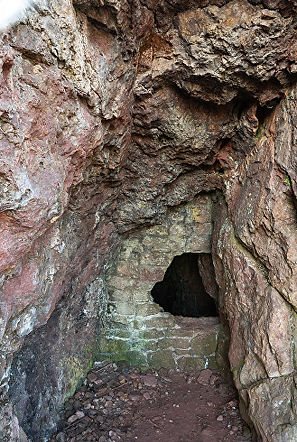
Photo: Irene Rogan
Hodbarrow Quarry Wall

Photo: Phillip Green
TOWSEY HOLE DRIFT MINE
A drift mine is an underground mine in which the entry or
access is above water level and generally on the slope of a hill, driven horizontally into the ore seam.
BETWEEN BRINE AND VAPOUR
The artworks drew inspiration from a work by the Millom poet Norman Nicholson 'Bloody Cranesbill'. 'Between Brine and Vapour' introduces a theme often incorporated into Irene's work. Specifically, Irene examines the way in which elements of the natural world are often unique to their location but only become visible when viewed under a microscope. The photographs follow the process of collecting both fresh and sea water from Hodbarrow alongside the microscopic specimens this activity produced. this is exploration of the waters surrounding Hodbarrow through water collections, observation and microscopy.

Photo Irene Rogan: White Rock, Millom

‘But inches below
The enveloping film
Between brine and vapour
The lesser energies
Explode into self-propulsion
Single cells
Developing fins
Tentacles, tails;
A tiny octopus
Rayed like the sun
That moves as the sun can’t’
Extract from Plankton by Norman Nicholson from series in the Shadow of Black Combe 1978
Photo: Member of the public Irene during water coillection at Haverigg

Water Collection - Hodbarrow broken inner barrier

Microscopy of Landscape

Microscopy and landscape Haverigg Point

Left Photo Philip Green quarry pool Right photo Irene Rogan & Microscopy
FLAMING FLEECES
The final series of images 'Flaming Fleeces' reflect on the landscapes visible from Hodbarrow and against which industrial Hodbarrow is set in constant juxtaposition. These are landscapes in which it is possible to trace human settlement back over thousands of years and in which ways of living are subject to an ongoing process of adapting. Specifically, flaming fleeces offer a lament to the region's heritage as a wool producer; it reflects upon the ways in which this once-valued fibre has now become little more than a waste product.


Photos: Phillip Green of Irene Rogan's performanative Flaming Fleeces installation.


Photo: Irene Rogan White Rock tide line

Photo Phillip Green of Fleece Industria' installationl by Irene Rogan

Video Jem Freiesleben: Flaming Fleeces, installation, Irene Rogan, Cumbrian farmland

Photo: Irene Rogan from Flaming Fleeces video filmed by Jem Freiesleben
Irene Rogan in discussion with
Adam Day Director of
The Farmers Network
WITH SPECIAL THANKS
photo Irene Rogan

Photo: Irene Rogan 'Flaming Fleeces' installation
Norman Nicholson Estate
Beckside Farm, Whicham Valley
Photographer Phillip Green
Lowscales Farm, Millom
Jem Freiesleben
Duane Farren
The Freshwater Biological Association, Hawkshead
Adam Day The Farmer Network, Cumbria