
International Research
Barcelona
Helena Ubach
Institute of Cosmos Sciences of the University of Barcelona
My international research began with conversations arising from the Art & Science Day at ICCUB, “Sonification and Astrophysics”. I met doctoral physicist Helena Ubach to discuss her work in sonification, ahead of the forthcoming Sonic Intangibles workshop. This encounter introduced me to the debate within science around how far artistic interpretation and creative transformation should influence the sonification of scientific data - a question that became significant to my own research.
The dscussion covered:
Movie about gravitational waves: https://www.ligo.caltech.edu/video/ligo20160211v1
Gravitational lensing images, for example from the Webb telescope:
https://esawebb.org/wordbank/gravitational-lensing/
Our document explaining the sonifications: https://arxiv.org/pdf/2407.09588
The website with sonifications, from Jordi Espuny (click on each of the websites): https://zoom3.net/sonificacions/
I also added edited the websites with some instructions:
https://helenaubach.github.io/sonification/1-unlensed-gw-sonification.html
https://helenaubach.github.io/sonification/2-lensed-gw-visualisation.html
Reionisation timeline: https://cdn.arstechnica.net/wp-content/uploads/2016/06/Reionization-timeline.jpg

A familiar Infographic
Institute of Cosmos Sciences of the University of Barcelona - Permanent Exhibition


White Rabbit
Passeig de Gracia 55, Barcelona
My research also took me into Barcelona’s independent, off-street Catalan art scene. White Rabbit was a labyrinthine space filled with surprising and contrasting work - vibrant, sharp, myth-exploring, political, technological, light and sound-based and ‘serious play’, with ideas colliding with a sense of fun. I found the experience refreshing: playful and irreverent, but underpinned by serious artistic enquiry.


Vienna
Professor Ille Gebeshuber
Professor Ille Gebeshuber at the Vienna University of Technology,
I was invited by Professor Ille Gebeshuber to visit her laboratory at TU Wien. Her research in biomimetics, diatoms and nanotechnology is internationally cited, and she is a widely recognised science communicator, having given multiple TEDx talks and authored several books on biomimetics. The visit included a tour of the lab and an introduction to the city, along with an invitation to a major cultural event at the Federal Ministry for European and International Affairs, Arts and Culture — followed by a further evening hosted by the university's Academy for Continuing Education department at a rural restaurant. My visit with Professor Gebeshuber's is also recorded by the university.
Arrival/Lab tour


"Rare samples, Institute of Technology Vienna — undisclosed for confidentiality

Ille displaying one of the mycellium bricks for sustainable architecture from 'Mycellium Art and Interdisciplinary Learning'


The Black Boards

The cultural event at the Federal Ministry for European and International Affairs, Arts and Culture
Linz
Ars Electronica 2025
Festival for Art, Technology & Society
Ars Electronica Festival, Linz (2025) — "PANIC – yes/no"
Ars Electronica is Europe's largest festival for art, technology and society, held annually in Linz since 1979. The 2025 edition, staged across POSTCITY and other venues from 3–7 September under the title "PANIC – yes/no," drew over 122,000 visits and brought together 1,472 artists, scientists and activists from 83 countries, with 379 exhibits and 684 events across the five days.
The theme responded to a moment of compounding global instability - political, ecological and technological - asking whether panic is simply paralysis or can function as a signal that mobilises change. As the festival's press materials put it, tipping points in politics, technology and ecology now confront us everywhere, and in the shadow of these crises both individuals and societies are under mounting strain. Artistic Director Gerfried Stocker framed the festival's response not as alarmism but as cultivating a "kind of digital immune system" a critical awareness that lets society metabolise shock rather than be overwhelmed by it.
the official interview page ars.electronica.art/panic/en
Images below document my visit to the 2025 festival and some of works encountered there
Phonos
PHONOS - Mark Vilanova
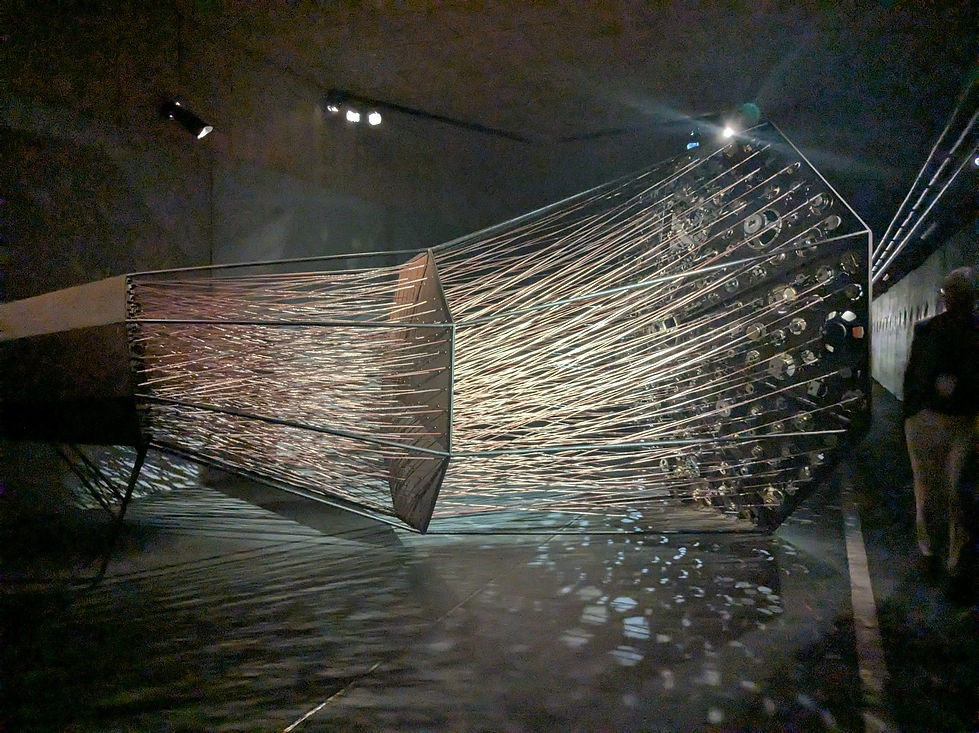
Infrasounds drift beneath the threshold of human hearing. Despite remaining largely unresearched and unregulated, these low-frequency vibrations shape ecosystems and impact the well-being of humans and more-than-humans.
Phonos is a sculptural installation of 208 recycled speakers—each one restored, stripped of its cone, and reprogrammed to receive a unique infrasound. Too small to voice these signals into the air, the speakers reveal their mechanical effort: coils vibrate, membranes ripple in tension and metallic components creak. An algorithm modeled on collective animal behaviour sequences their movements into an ever-changing polyrhythm of tremors and buzzes.

Fluid Anatomy
FLUID ANATOMY - Ioana Vreme Moser
Fluid Anatomy is a purely analogue system powered only through water and air, based on components and circuits from fluid mechanics. The installation implements a fluidic model in which water and air carry information. This fluidic computer fills the entire space with its swirls, pulsating fluids and vibrations.
Fluidics, also known as fluid logic, is a research field established in the 1950s that uses fluid jets to perform operations similar to those achieved through electronics. In fluidics, form follows function, curved intricate cavities become switches that can resist radiation and environmental decay. Such shapes were sent into space, powered automation machines (Soviet Volga Jet System) and heart valves.

Guanaquerx
GUANAQUERX - Paula Gaetano Adi
Guanaquerx is a robot seeking freedom. Poetically restaging San Martín’s epic expedition that brought the liberation of Argentina, Chile, and Perú from Spanish colonizers, Guanaquerx is a project about designing and implementing technologies otherwise. A collaborative and collective feat aimed at repairing the structured unsustainability of mainstream AI and robotics and imagining an emancipatory technological practice that defies modern/Western innovation goals of space colonization and the exploitation of natural resources.
Awarded the Orix Ars Electronica 2025 - Golden Nica - Arificial Life & Intelligence
Hardware, Socially-Engaged Art, Socially-Engaged Technology, Software, Technology, Video

Rheometer concert - participant -audience
SONIC SATURDAY: Audible Denial, Sonic Unheard
Anton Brukner University
Curated by C-LAB Taiwan Sound Lab, a guest performance by the Mexican Centre for Music and Sonic Arts, and the MEDIUM SONORUM. The event included Spatial sound concerts, live performances and sound installations.

tele-present - wind
Tele - Present Wind - David Bowen
This installation is a collaboration with the NASA Jet Propulsion Laboratory. The piece consists of a series of 84 x/y tilting mechanical devices connected to tall dried grass stalks, installed like a field in the gallery. The mechanisms will tilt, move and sway based on data collected from the wind sensor on the Perseverance Mars rover.
Dr. José A Rodríguez-Manfredi, lead scientist on the Mars Environmental Dynamics Analyzer on Perseverance, assisted in collecting the wind data for the project. That data is mapped to the movement of the mechanisms. Thus, the individual components of the installation here on earth will move in unison as they mimic the direction and intensity of the wind from another planet.

Sobbotsco
SOBBOTSCO -Alberto Anhaus
SOTTOBOSCO is an intermedial installation that imagines a post-natural undergrowth shaped by both organic and artificial life. The project explores how ecosystems might evolve in response to the infiltration of synthetic materials, drawing inspiration from the project Flora robotica—an architectural system that merges living plants and distributed robotics. At its core, SOTTOBOSCO questions how hybrid environments may redefine nature. Audiences encounter a large box-shaped structure resembling a terrarium evoking a tree trunk. Here, micro-robotic insects generate sounds and movements.
FINALE EVENING EVENT ON THE RIVER DANUBE BEFORE CLOSING THE FOLLOWING AFTERNOON


