
Laboratory
Investigation 01
Resonance and Pattern
Handbell Ringing Experiment
Context
These form a practical strand of the Ocular Mediation research, developed in conjunction with the Sonic Intangibles programme.
I invited Dr Gary Caldwell (marine biologist), Dr Tassia Ferreira (cosmologist) and Dr Claudia Racca (neuroscientist) to take part in a series of laboratory experiments exploring patterns and behaviours across different scales. Working alongside members of the Sonic Intangibles team, including Dr Chris Harrison and Dr Jorge Boehringer, we used simple material systems, handbell sequences, layered mesh, and stratified water to open shared questions about perception, structure, relationships and disturbance.
Conversations with Professor Paul Vickers also prompted me to look beyond the translation of scientific data into sound and to consider sonic art more broadly, including how we encounter and understand our sonic environment. This expanded my thinking about sound as a means of mediation rather than simply as another way of representing data.
Gary Caldwell contributed microbial datasets that became the starting point for the first laboratory investigation, in which handbell ringing was used to explore ordered relationships through sound. The sessions that followed remained open-ended, prioritising collective observation, dialogue and the insights that emerge when artistic and scientific approaches meet.

Dr Gary Caldwell, on the Algal data
I propose to convert data from one of my Stage 3 undergraduate dissertations (Ms Tasha Salah) into two sets of campanology rules.
This is the background to Tasha’s research. There is growing interest in investigating whether human lifespan extension is pharmacologically achievable, with several candidate drugs identified. Rapamycin is widely used in chemotherapy and organ-transplant rejection prophylaxis. It has also been shown to restore regenerative capacity within cells. Tasha’s project was to determine whether exposure to rapamycin over a range of doses could extend the ‘life span’ of microalgae cultures, in essence, looking for an ‘eternal’ algal cell. She exposed cultures of Chlorella to rapamycin over a 14-day period and took cell counts as well as measures of the alga’s photosynthetic health.
The cell count data is shown in the upper graph. Each coloured line is a separate rapamycin dose ranging from 0.1 up to 100 micromolar. There are two control treatments (0), one with a solvent and one without. Rapamycin is insoluble in water so it has to be dissolved into what is termed a carrier solvent – in this case a chemical called DMSO. The carrier then allows the rapamycin to be dispersed in the water.
Tasha’s data are complex and tell a very interesting story that follow a pattern of hormesis (crudely, that which does not kill me makes me stronger). Lower drug levels did improve the culture while higher levels were toxic. It is this two-tone response of the algae that gives the data complexity and, in my view, makes it suitable for the campanology exercise as the order of the treatments change through time. I envisage each rapamycin dose to correspond to a separate bell, so that as time elapses the order that the bells are rung changes.
The second graph is the output of a statistical model that was fed the photosynthesis health data. All the funny terms on the right-hand axis are each a different measure of photosynthesis health – the meaning of each parameter isn’t needed for this exercise, but the reason why I want to include this is that it presents a different picture to the cell data. I view the photosynthesis data through a lens of ‘entropy’. In biology, entropy is a measure of molecular disorder. Living organisms are highly ordered, low-entropy systems that constantly combat increasing entropy by importing energy (e.g., food, sunlight) and exporting disorder as heat. I felt that these data could be interesting to include as they involve a series of times when the data converge and diverge, creating a wavelike pattern. If this pattern can in turn be reflected in a shifting of the timing between bell rings it could present a quite dramatic performance, almost akin to a pattern of breaths being taken. I like this analogy as moving from left to right along the graph you see the cultures growing (data diverging), then they become stressed (data converge), they recover (data diverge again) before finally almost all treatments have died and the data converge for the final time. I like the breathing analogy as it speaks to the fight for life as well as providing echoes that 50% of our oxygen comes from algae.
This is also partly why I answered carbon when you asked me which tone I personally would find meaningful. Entropy plays into this too as life resists entropy by creating order from chaos, with the need for carbon being the unifying principle across all lifeforms. Algae are ‘born’ and have to capture carbon through photosynthesis to grow (fighting against entropy), and when they die entropy wins and the carbon is release and returned to its chaotic state.
Response to Gary Caldwell
Irene Rogan
Artist
Gary's illuminating explanation helped to open up the scope of interpretive possibility. What had initially appeared as a complex set of biological measurements began to suggest a cycle of growth, stress, recovery and decline. Gary's choice of carbon as the underlying theme particularly resonated with me, because carbon is continually taken up, transformed, incorporated into living systems and eventually returned.
By this time I was already exploring handbell ringing as a way of working with mathematical permutations, alongside my research into quantitative comparison and persistent homology. The data provided a means to further test my ideas. Translation into the change ringing sequence and the timing of the bells appeared to work, in addition to this Gary's explanation provided alternative reading.
The idea of restoration within the experiment began to connect with the much wider cycles of renewal found throughout nature. Growth and decline are not necessarily endings, but part of a continual movement between states. Carbon makes this particularly resonant. It is captured, becomes part of living matter and, when that life ends, is released and made available again. What appears to be an ending can therefore become part of something else. The algae are one point within a much larger circulation of matter. For me, this is where the scientific account begins to open into metaphor. The handbell ringing offers a way of attending to the movement within the data, while the data itself prompts thoughts about renewal, restoration and the possibility of transformation beyond an individual life.
The Hand Bell Ringers
Cumbrian handbell ringers and University of Newcastle scientists test the data
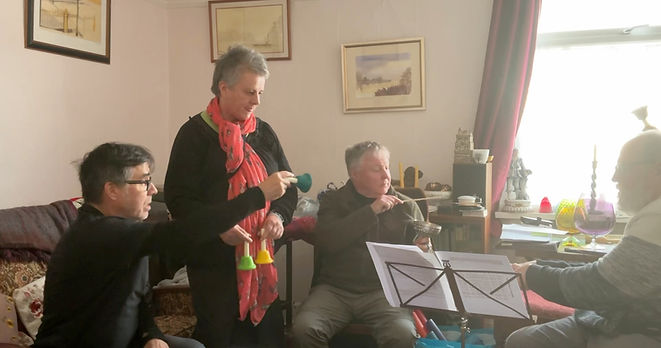
Local handbell ringers testing the algal data sequences (Cumbria)

The full sequence of ringing algal data
Dr Jorge Boehringer, Dr Chris Harrison, Dr Gary Caldwell, Elizabeth Sharpenson and Irene Rogan ringing the algal data (Newcastle Culture Hub

The video was created for the Sonic Intangibles Interdisciplinary Knowledge Exchange event. Rehearsals for ringing Gary Caldwell's algal data using traditional handbells whilst n the bell tower of Broughton in Furness church.
Making the Invisible Legible
Much of the universe exists entirely outside our natural human senses. We cannot see the radioactive loops of the sun, and we cannot hear the silent, microscopic life cycles of micro-algae.
My work with data sonification, translating Dr Gary Caldwell’s algal data into a mathematical handbell permutation, is part of a deeper, universal human obsession: a drive to build a sensory bridge to the invisible and make silent data legible.
Observing the diverse approaches within the Sonic Intangibles network reveals that we are doing more than just analysing spreadsheets. By turning hidden patterns into something we can physically hear and feel, we are responding to an inherent need to connect with an underlying order. We are attempting to listen to a universe that is constantly speaking, whether we fully realise it or not.
About the Performance: The Technical & Aesthetic Approach
This performance translates 360 hours of scientific laboratory data tracking micro-algae exposed to rapamycin into a live acoustic piece:
-
The Structure: The 360-hour timeline was compressed into a grid of 12 sections. Because the data originally called for 12 distinct tones, the mathematical data points were adapted into a permutation for eight handbell ringers, capturing the most prominent moments of change.
-
The Biological Arc: The bells track the algae from its initial growth to its entropic decline. As the micro-algae faded under the toxin, the ringers allowed the resonance of the bells to naturally decay and fade into silence.
-
The Grounding Note: Underlying the entire piece is a single, continuous bell sound representing Carbon, the foundational element of the organism - sustaining the performance from start to finish.
Investigation 02
Disturbance and Emergence
Moiré Mesh Experiment

Experimental Laboratory with Dr Jorge Boehringer, Dr Gary Caldwell and Dr Chris Harrison participating in the Moiré Mesh experiment at Newcastle University Culture Hub

An example of the moiré effect of one of the mesh materials used in the experiment
Context
In response to the handbell experiments - employing sonification to explore structure, interconnected systems and material behaviour suggested by the algal data, I wanted to introduce a new perspective and to examine the way in which patterns emerge through movement and disturbance. To extend these questions emerging from the handbell investigations, I explored suspended layers of mesh as a simple experimental system for observing how patterns emerge through movement and disturbance.
Layers of organza, net curtain and reclaimed mesh were suspended and gently disturbed (see image above) producing continuously shifting moiré patterns that changed with movement, light and viewing position. Rather than illustrating scientific concepts directly, the experiment explored whether processes such as disturbance, emergence, layering and changing relationships might offer another way of thinking about characteristics encountered across microbial, neuronal and cosmological research. The laboratory session, undertaken with members of the Sonic Intangibles team, and marine biologist Dr Gary Caldwell, encouraged discussion about how simple physical experiments can open new perspectives on complex scientific ideas.
Laboratory Handbells and Moiré Mesh Session
Present: Dr Gary Caldwell, Dr Jorge Boehringer, Dr Chris Harrison Artist Irene Rogan, Mucsician Elizabeth Sharpenson. The mesh became a material through which disturbance, connectivity and structural response could be explored.
Interdisciplinary Dialogue
Response
Dr Tassia Ferreira
Cosmologist, on the mesh dialogue

I feel that you add so much art to my research. When you mention a new medium, I am quickly able to bring it back to my research, in a way I wouldn't have thought possible. I'm very thankful for you making me see things differently - otherwise I have a really hard time communicating my research.

Gravitiatonal lensing

Spacetime grid diagram

Gravitational well render
It is interesting to see untraditional mediums - meshes, sounds, internal waves - that aren't common in my field as a cosmologist, and how scientists from different fields interpret them and connect them to their own research. I was able to look at a simple mesh, the way our fingers or bodies distort it, and picture how celestial bodies interact with spacetime.
Hearing the different interpretations from Claudia and Gary allowed me to see into their research and understand we're not so different at all. Processes like "perturbation" get translated into "stimulus" in neuroscience - the physics or biology is different, but we can understand each other without the scientific formalism, just by focusing on the art. We started out looking for patterns between datasets across different scales, but I find a pattern in the way we work, the way we think, the way we look at problems. It can seem obvious that all scientists are alike, but that's not clear in our day-to-day work and analyses. This pattern is clear to me now, and it wouldn't have been possible without Irene's intervention.
Dr Claudia Racca
Neuroscientist, discussuion on the mesh experiment
In separate discussion with Dr Claudia Racca a neuroscience. perspectives was introduced As our conversation returned to the mesh experiments, Racca produced an initial sketch of a synaptic pathway — the material's layered structure suggested to her a way of thinking about architecture as built up in layers, echoing synaptic organisation. This was later elaborated into a more resolved sketch of synaptic progression, considering the mesh materials and their suitability for a large-scale installation referencing neural pathways.

Claudia's sketch of synaptic progression towards the development of an installation
Irene Rogan
Artist
Of ideas from discussions on the mesh experiment
Immediately following my discussions with Tassia and Claudia I began to sketch out ideas for a physical structure incorporating mesh (referencing Claudia's ideas around synaptic progression) to form a tunnel like passage. The passage would lead through a doorway where the work would gradually introduce new cosmology inspired ideas incorporating mesh, light and event horizon imagery. I also began to consider sound and ways of moving through the work, creating an experience of passage between spaces while drawing on characteristics identified through across scales connections, voids, boundaries, branching and changing relationships.

Concept scribble fordevelopment following laboratory dialogue

Concept development following Laboratory Research dialogue with Tassia and Claudia
Investigation 03
Laboratory Excursion
This phase of the work brought together alongside myself Dr. Claudia Racca (Neuroscientist), Dr. Gary Caldwell (Marine Biologist) and Dr. Tassia Ferreira (Cosmologist ) in a collaborative programme of interdisciplinary enquiry.
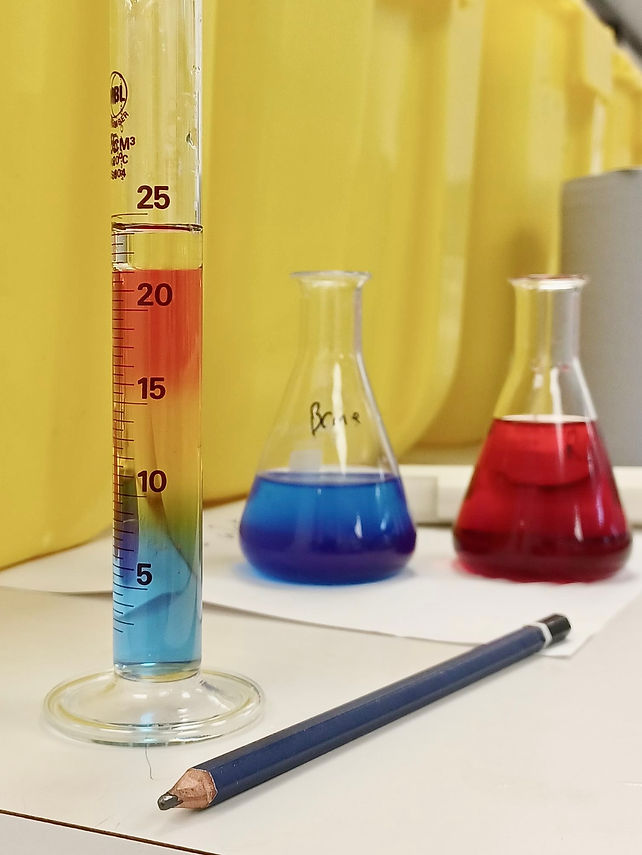
Photo Dr Gary Caldwell The graduated cylinder with the blue and red layers and pencil.
The laboratory excursion was conceived as part of the creative process of Ocular Mediation. Rather than beginning with a predetermined artwork, I wanted to create a situation in which the encounter itself could become part of the work.
A central part of this was bringing three scientists from different fields - Dr Gary Caldwell, Dr Claudia Racca and Dr Tassia Ferreira - into the same laboratory environment. This was an unusual situation that none would ordinarily encounter in their work. Their presence together, with their different ways of seeing and working, became a creative act: a performative encounter between different forms of knowledge.
The investigations explored water, density, buoyancy, dyes and light, with aspects of fluid dynamics informed by Dr Magda Carr’s research into solitary waveforms. This connected with my wider interest in forms and processes that operate across scales, including movement, rhythm and sound.
The small-scale work became particularly revealing. Dr Claudia Racca and Dr Tassia Ferreira created images on microscope slides using dyes and laboratory equipment. Claudia’s images suggested possible microbial forms, while Tassia’s produced unexpected cosmological associations - one suggesting a star cluster or nebula, another appearing almost planetary.
Tassia’s reflection afterwards was particularly helpful:
“In the beginning you talked about connecting the micro and the cosmological. I feel like that is exactly what we did in the lab. Not through formulation and quantification, but through different perspectives.”
Her observation brought together something I had been exploring throughout Ocular Mediation: that connections between scales can emerge through perception and association rather than scientific equivalence. The microscope becomes a mediator, allowing a small-scale material encounter to open onto something that appears cosmological.
The wall of instant photographs provided a further collective element. Each participant made an image and gave it a title, creating a shared record of the day and its different perspectives.
Three Scientists and an Artist

L: Dr Tassia Ferreira R: Artist Irene Rogan
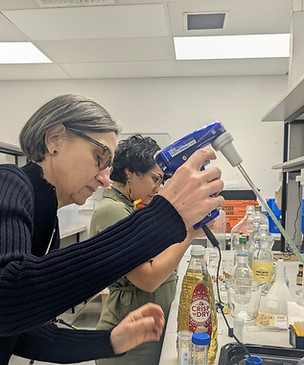
Foreground : Dr Cluadia Racca
Rear Dr Tassia Ferreira

Dr Gary Caldwell
The Tank Experiments
Developing the pycnocline
Why it's important in Fluid dynamics research


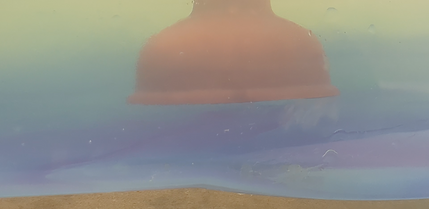
Water tank looking up, view the almost invisible pycnocline
Developing the Pycnocline in the large tank Dr Gary Caldwell
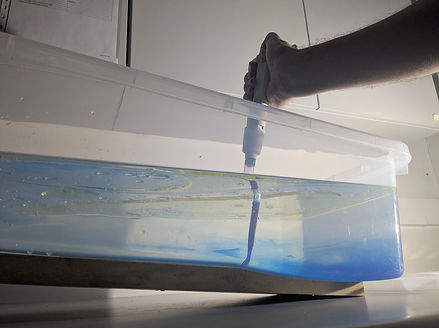
PYCNOLINE
A pycnocline is a layer in a body of water where density changes rapidly with depth. It can form where water masses with different temperatures or salinities meet, creating a boundary between them.
This invisible boundary is important in ocean dynamics because it can influence the movement and behaviour of water, nutrients and energy.
Dye entering tank

Claudia working tank - creating a miniature wave

Tassia working the tank - Claudia's model boat - following movement


Buoyancy — an object responding to the density conditions
Ice — introducing a new material/temperature condition

Plunger — actively disturbing the water
Small Scale Tests
Context
Alongside the large tank, each of us ran small-scale versions of the same conditions, density, dye and buoyancy - in individual jars and vessels. These experiments allowed us to observe the behaviour of the materials at a more intimate scale, while also generating unexpected visual forms. Dye was introduced onto microscope slides, producing transient images that suggested cosmic or microorganism-like structures. A wall of instant photographs documented these experiments, creating a collective visual record of the changing forms and interactions and moments caught in passing.
Coloured cluster II
Tassia's worlds

Star Cluster : Created using microscope slides and dyes

Planet: Created using microscope slides and dyes
Claudia's Observations

Amber/bubbles

Colour cluster I: created on microscope slides with dyes

Colour Cluster II created with microscope
slides and dyes

Green orange: created with microscope slides and dyes

Palette

Projection
Gary's


Gary's experiment: The beauty of water, glass and light
Fugitive Field Study
Irene's observations
These images are a departure, moments caught in passing, off to the side of the formal record, where something in the light, the material or the moment itself asked for a second look.

Starlit Ray - caught from the bench

Observing Claudia through amber

Indelible presence: Dr Gary Caldwell Marine Biologist Researcher Senior Lecturer


Original Photo Credit Gary Caldwell : Irene's Moody Stratified Space Sequence

In or out
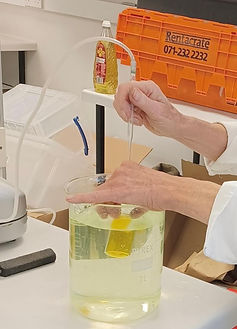

Tassia's test - All Eyes
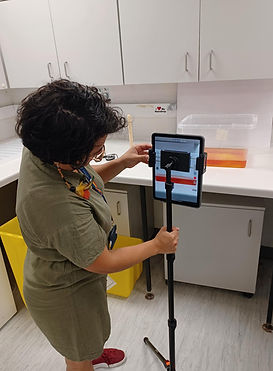

L: Dr Tassia Ferreira and R : Dr Claudia Racca Documenting their experimenters using iPad and Instax camera
Enduring the bubbler

''All In The Title'. Each participant made and titled instant photographs during the laboratory session, creating a collective record of observations, encounters and different ways of seeing.
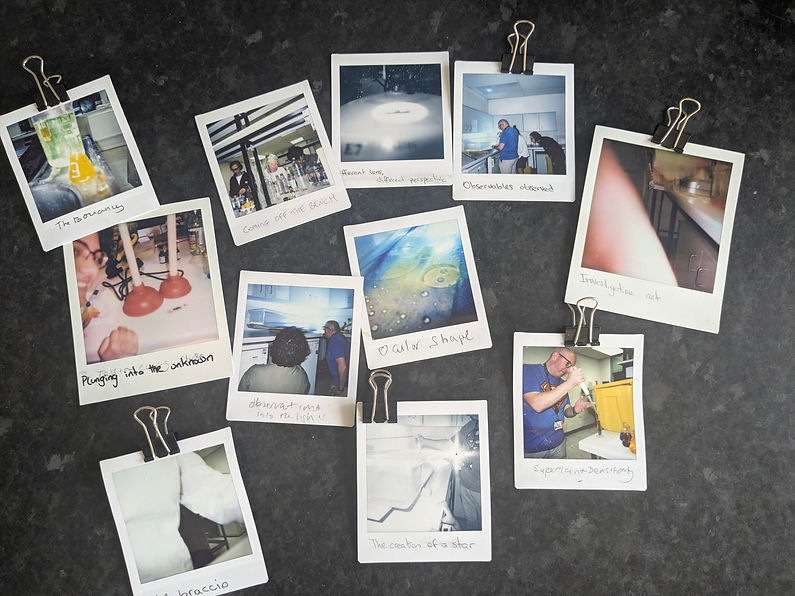
Detail from the collection - All In The Titles - the wall of instant photographs
