
Upwelling
Investigation 04
Mutable Densities
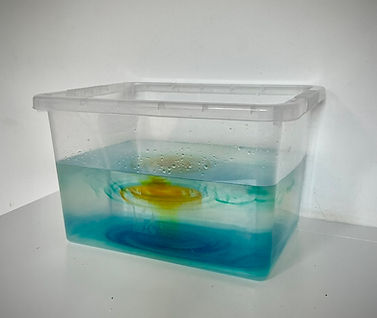

Pycnocline, salinated water and dyes
The laboratory work explored stratified water, including the formation of a pycnocline - a boundary between water layers of different density - through salinity, dyes, buoyancy and movement. Mutable Densities explore how density can shift, separate and interact through water, movement and material.
Working with three scientists from different fields in the laboratory was part of the creative work. It allowed me to observe these processes directly and consider how they might translate into my own practice. Following the laboratory, I continued experimenting independently, creating several at home, using salt, water, colour, oil and different vessels to explore density, stratification, interfaces and buoyancy on a small scale. This became an important transition in the research: from observing fluid behaviour in the laboratory to developing my own material and visual responses, and towards Upwelling.
Laboratory Experiments
From Argo Programme to Local Observation and Floats
Marine biologist Gary Caldwell sent link about the Argo Programme https://www.ukargo.net/ and https://argo.ucsd.edu/ global network of over 4,000 free-drifting robotic floats measuring ocean temperature, salinity and pressure.
I was fascinated by how these small, autonomous instruments gather individual observations of the unseen ocean, contributing to a wider understanding of our shared planet. Inspired by the life cycle of the floats themselves. Around ten years into their working life, when a float falls silent, it can be recovered, with components restored or replaced. For me, this suggested a resonance with natural cycles: movement from activity to stillness, change and renewal within a larger system.
Upwelling is the movement of cold, nutrient-rich water from the depths towards the sunlit surface. As these nutrients become available, they support phytoplankton and other marine life, forming the foundation of highly productive marine ecosystems.
This process became both the scientific and poetic starting point for my investigation. The Argo floats provided a model of autonomous instruments moving through the water column, gathering information about an environment that cannot be directly observed. I wanted to respond to this idea by making my own floats - not to replicate scientific instruments, but to ask whether a float might gather something differently: an encounter, a trace, an image, or a sense of the environment it moves through.
The metaphorical dimension of upwelling is equally important. What is held below can rise towards the surface; what is unseen can become perceptible; material that has accumulated in the depths can become a source of new life. Upwelling therefore carries ideas of emergence, regeneration and renewal, as well as movement and exchange.
My floats, water experiments, cyanotype and microscopy are ways of exploring these ideas materially. They allow the research to move between scientific observation and poetic interpretation, between data and experience, and between what can be measured and what might be sensed or imagined.
Buoyancy test
Salinated water column 'jumper pattern'
Hand Bell Research
An emerging sonic element of Upwelling builds on an earlier strand of Ocular Mediation research, in which algal data was translated through the mathematical permutations of change ringing. This work was developed through collaboration with marine biologist Gary Caldwell and his research data, and provides a precedent for bringing ecological data into a shared sonic and participatory form.
The Work
Fleece Float
The following experiments have developed from this ongoing investigation. Each explores a different way of gathering, recording or making visible environmental observation

Fleece Float
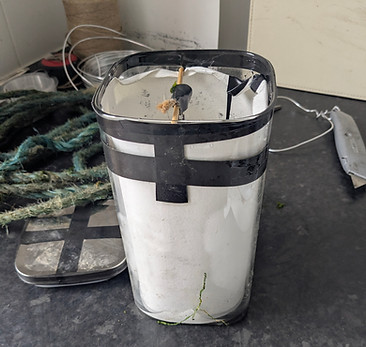
Raw fleece-wrapped float ready to be launched at the interface between the estuary and river mouth in Haverigg designed to collect and retain material encountered during its movement through the water.

Retrieval collected from river and estuary inteface
Microscopy
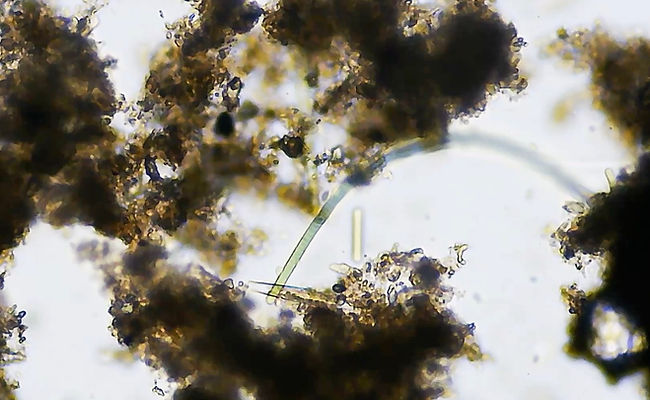
Filamentous cyanobacterium (?) - material collected from the fleece

Micractinium (top right)

Sphagnum moss

Testate amoeba (Argynnia sp.?) recovered from collected material
Drawing The Tide Float

Drawing the Tide Boroscilate jar, wood, lead weight, willow charcoal, fishing line, jute, insulation tape, aluminium wire, marine rope.
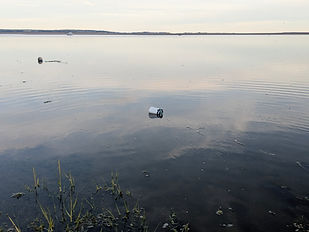


In the field: Drawing The Tide deployed in Duddon estuary an unexptectedly calm tide for this region
The retrieval

Detail

The tidal drawing - Record from an unusualy calm tide for this region
Microscopy

Charcoal juice microscopic - material collected from the float

Charcoal juice Charcoal particles suspended in water from inside the float


Microscopy equipment, materials and vessels used to examine the collected traces from estuary and river
Investigation 05
Water collections and microscopy
Commencing the Hunt I
A series of seaweed and seawater collections

Haverigg collections from river mouth and estuary
Microscopy
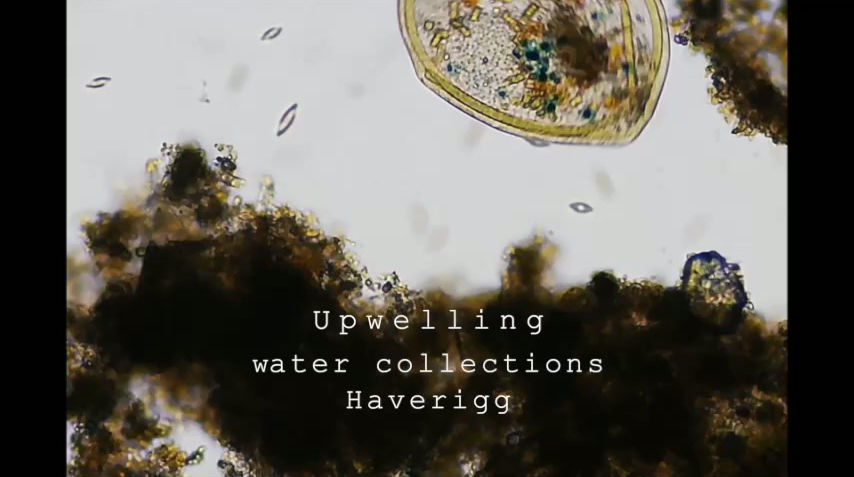
Nassula sp?


Scenedesmus sp.

Surirella sp.


Investigation 06
Water Collections: Cyanotype, Seaweed and Microscopy
Cyanotype is itself a recording process. Light initiates a chemical transformation in the iron-based emulsion, producing the characteristic Prussian blue image. This introduces another material relationship into the investigation: biological material, seawater, light and iron-based chemistry brought together on a receptive surface.
The intention is not to depict or illustrate the seaweed or microorganisms within the water, but to explore whether an encounter between biological material, seawater, light and the cyanotype surface can leave a trace. The resulting marks are not assumed in advance to have a particular cause; they become part of the investigation, something to observe, question and follow.
Alongside the cyanotype work, I am using microscopy to examine collected seawater, seaweed and microorganisms at a scale that cannot otherwise be seen directly. Marine diatoms have already been observed in seawater collected with seaweed from Silecroft shore. I will photograph and observe the microscopic forms that emerge, rather than making identification the primary objective.
Cyanotype – light-induced chemical transformation.
Seaweed – biological material and environmental encounter.
Microscopy – magnification, observation and recording.
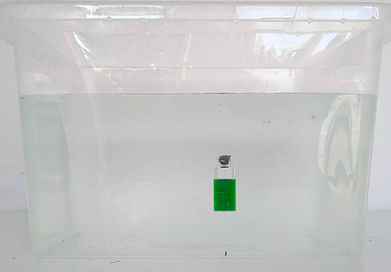
Water Column Test – Upwelling: what happens to the float when colder, denser deeper water moves upwards into warmer water above?
Together, cyanotype and microscopy offer different forms of mediation. One allows an encounter between biological material, light, water and iron-based chemistry to leave a material trace; the other reveals biological forms through magnification. Both extend my material response to oceanographic instruments such as Argo, which record through movement, position, immersion and physical measurement.
The investigation remains deliberately open. I am not trying to determine in advance what the cyanotype should record, or to attribute a resulting mark to a particular microorganism without evidence. Instead, I am commencing the hunt: collecting, exposing, observing, photographing and looking for traces of what might otherwise remain unseen.
Detail: Method of precision buoyancy- a small jar and a pebble!
Multiple Test Float - uoyancy experiment, cyanotype paper and wild carrot collected from the river edge. The float positioned the paper across the water surface, creating different UV exposure above and below water and producing variations in the resulting traces.
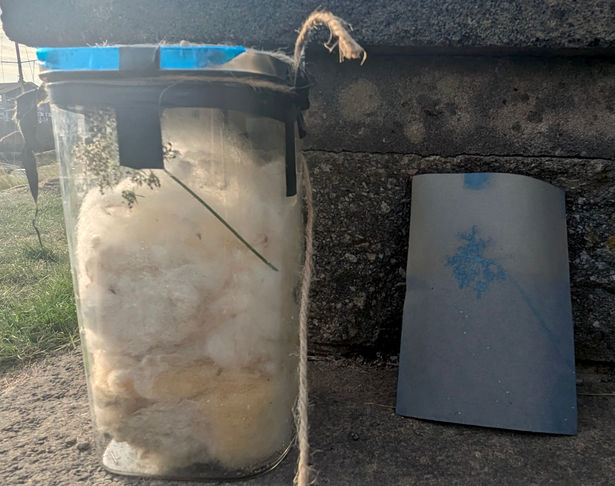
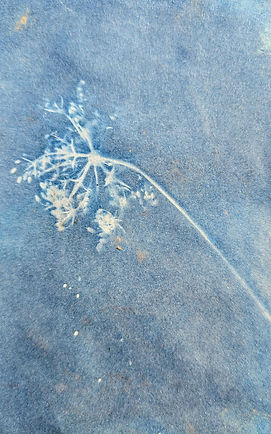
The Cyanotype paper with full UV exposure washed later
Detail: Multi-float with wool padding and wild carrot plant, cyano paper with UV exposure variation

Control test L-R 1. seaweed, 2. none 3.freshwater 4.seawater on paper and glass

Control test Seawater - long exposure - 4 hours
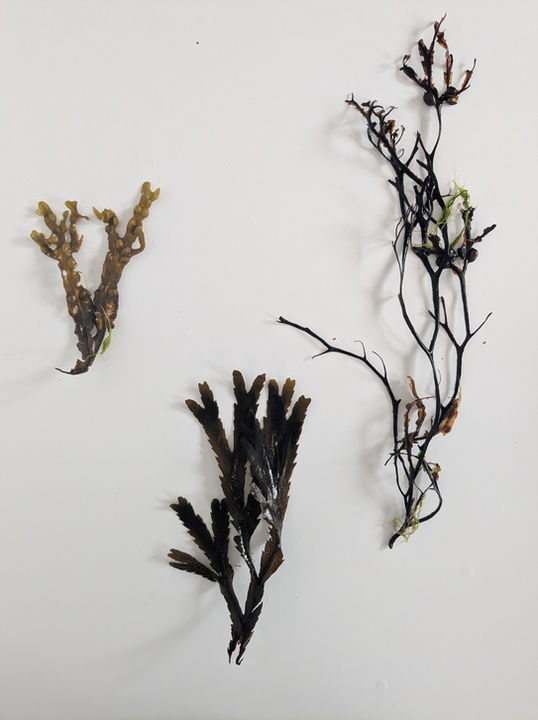
L: Ascophyllum nodosum Egg wrack / Knotted wrack Centre: Fucus serratusSerrated wrack / Toothed wrack R: Fucus serratus Serrated wrack / Toothed wrack - Interestingly the water collected during incoming tide at Eskmeals produced no observable microorganisms
Next
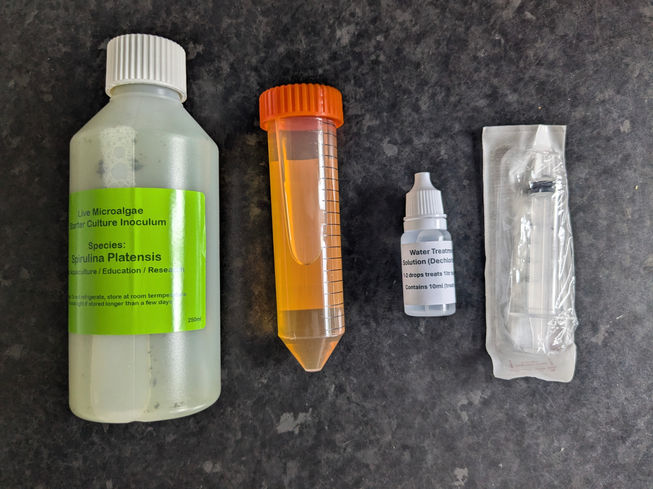
Spirulina platensis live culture - Est arrivé
copyright © 2026 Irene Rogan

