
Ocular Mediation
Interdisciplinary Research in Art, Science and Perception
Experimental laboratory - stratified fluid/light
Introduction
Ocular Mediation is a interdisciplinary research project exploring patterns, structures and behaviours across three very different scales: the cosmological, the neuronal and the microbial.
The research began with a fascination with the visual relationships that can emerge between seemingly unrelated systems, the cosmic web, neuronal networks and the branching structures of microbial life. Rather than suggesting that these systems are equivalent, I became interested in how patterns emerge within them, how they are observed, and what happens when different scientific ways of seeing are brought into dialogue.
The title Ocular Mediation refers to the role of the eye and the instruments that extend it - in shaping what can be seen and understood. Microscopes, telescopes, imaging systems, data visualisation and sonification all mediate our encounter with phenomena that cannot otherwise be directly perceived.
The research developed through collaborations with scientists and researchers in astrophysics, cosmology, neuroscience, microbiology and sound, alongside my own material experiments. Through these encounters, the original questions expanded and shifted, leading into new areas of investigation including sonification, scientific data, networks, microscopy, fluid dynamics, water and environmental observation.
Sonic Intangibles
As part of developing the proposal, I contacted the Astrophysics Department at Newcastle University and introduced myself to Dr Christopher Harrison. Our initial conversations led to the possibility of collaboration and subsequently to my involvement with the Sonic Intangibles team.
Following the award, I began conversations with Dr Christopher Harrison (astrophysicist), Professor Paul Vickers (computer scientist) and Dr Jorge Boehringer (sound artist and composer). The planned workshop, originally intended for May 2025, subsequently took place in September 2025.
This became an important entry point into the research. Working with the Sonic Intangibles team opened up new ways of thinking about data, sonification and perception across different fields, and began to shift the project beyond the original proposal. This was particularly relevant to Ocular Mediation, where the question was not simply how scientific phenomena are represented, but how information from very different scales and fields can be encountered, translated and perceived through different forms of mediation.
https://sonicintangibles.github.io/about/
https://www.jorgeboehringer.com/
Developing the collaborations
The research then expanded through conversations and collaborations with scientists working in other fields. I invited Dr Gary Caldwell (marine biologist), Dr Tassia Ferreira (cosmologist) and Dr Claudia Racca (neuroscientist), to collaborate with me each bringing a different perspective, methodology and body of knowledge to the research.
These encounters allowed the original questions to develop through direct exchange rather than remaining theoretical. Laboratory work, discussion, observation and experimentation introduced new possibilities and, in some cases, redirected the research entirely.
The intention was never to establish direct equivalences between disciplines or to illustrate scientific ideas through art. Instead, the collaborations created an environment in which artistic enquiry and scientific knowledge could meet, allowing unfamiliar methods to challenge my assumptions and new questions and unexpected directions to emerge.


Physarum polycephalum ' slime mold' from Irene Rogan's Studio
The Millennium Simulation of the Universe
Neuronal network


The first interdisciplinary meeting bringing together the Sonic Intangibles team and scientists to explore the original Ocular Mediation proposal
Reflections on Humanising Data
Between Wonder and Delight
Rather than seeking to illustrate scientific principles, this research gradually became an investigation into how artistic enquiry can reveal recurring behaviours, relationships and questions on perception across very different scientific domains. What began as an exploration of translating scientific data through sound evolved into a broader enquiry into perception, experimentation and interdisciplinary collaboration.
Through conversation, collective experimentation and interdisciplinary exchange, the research evolved in unexpected directions, from handbell ringing and mathematical patterns to laboratory investigation and material processes. As the enquiry developed, the emphasis shifted from translating scientific data towards exploring perception, emergence and the relationships that can be revealed through artistic experimentation and dialogue across scientific disciplines.

Some of the participants during Sonic Intangibles workshop programme exploring ideas through discussion, drawing and collaborative enquiry. September 2025
Sonic Intangibles Interdisciplinary
Knowledge Exchange Event
14th September 2026
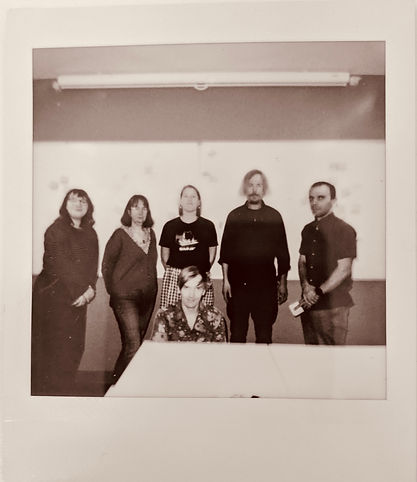
Sonic Intangibles team L-R: Becky Allen, Carol Davenport Dr Shelly Knotts, Dr Jorge Boehringer, Dr Chris Harrison. Centre: Dr Dan Ratliff

International Research
International research became an important part of the project, providing opportunities to encounter researchers, artists and different approaches to interdisciplinary practice.
Visits and conversations with Professor Ille Gebeshuber at the Vienna University of Technology, attendance at Ars Electronica in Linz, and meeting doctoral researcher Helena Ubach at the Institute of Cosmos Sciences of the University of Barcelona broadened my understanding of the varied ways art, science and technology can intersect. These encounters also prompted reflection on different approaches to scientific communication, particularly sonification and the interpretation of scientific data.
Together, these experiences helped clarify my own direction: rather than translating scientific datasets directly, I became increasingly interested in artistic enquiry as a way of exploring perception, relationships and questions emerging through dialogue across disciplines.
The International Research & Encounters submenu will document these experiences and their contribution to the developing research.

Ringing the Data: Local residents participating in an experimental handbell ringing session, exploring approaches to sonifying data
Laboratory Research
A significant turning point came through the Sonic Intangibles programme and monthly meetings with Dr Chris Harrison and Jorge Boehringer. Chris introduced research comparing neuronal networks and the cosmic web, which led me to read Quantitative Comparison Between Neuronal Network and Cosmic Web and subsequently Persistent Homology from a Creative Perspective. Engaging with this research was pivotal, directing my thinking beyond visual similarities towards recurring behaviours, structures and relationships across very different scientific domains.
At the same time, hearing church bells in my local community led me to discover campanology and the mathematical structures underlying handbell ringing. With the support of marine biologist Gary Caldwell, who shared microbial datasets and bell-ringing charts, I began developing handbell experiments as a participatory way of engaging with scientific information through sound and rhythm. Questions emerged from the handbell investigations concerning structure, interconnected systems and material behaviour. This led me to explore suspended layers of mesh as a simple experimental system for observing how patterns emerge through movement and disturbance, developed as the Moiré Mesh Experiment. The work opened discussions around neuroscience and cosmology, with potential for further development as an exploratory installation.
I brought these ideas to the Sonic Intangibles team, scientists and invited collaborators at Culture Hub Newcastle, where they developed through a wider exploration of resonance, translation and perception. The handbell research continues with a local ringing group, exploring Gary Caldwell’s algal datasets through live performance and recordings using historic church handbells.
Laboratory Research provides greater details of Sonic Intangibles & Handbell and Moire Mesh Experiments

Large Tank Pycnocline Experiment Science team

Small tank Pycnocline and stratified water - Irene Rogan
Laboratory Excursion
The Laboratory Excursion, created a collaborative space for interdisciplinary enquiry and knowledge exchange. Working with scientists from different fields, the investigations became shared points of enquiry through observation, dialogue and experimentation.
My role evolved from planned practical investigations towards observing, documenting and reflecting through the developing framework of Ocular Mediation. I subsequently continued the practical investigations independently, exploring density stratification, pycnoclines and buoyancy. This marked a significant shift in the research and laid the foundations for my continuing Upwelling research.
The Laboratory Research submenu traces this development through my encounters and exchanges with neuroscientist Dr Claudia Racca, marine biologist Dr Gary Caldwell and cosmologist Dr Tassia Ferreira.
Laboratory excursion is documented in more depth on the Laboratory Research page.

Fleece Float
Upwelling
An artistic exploration informed by oceanographic processes, developed through laboratory experimentation and observation.
Following the extended laboratory research Excursion with scientists, I developed my own small-scale experiments exploring pycnoclines, water density, stratification, buoyancy and fluid movement using dyes and salinated water.
Upwelling became a further direction through an interest in the movement of deeper, nutrient-rich water towards the surface, bringing nutrients into the sunlit zone to support marine life. This movement between depths offered a way of thinking about what remains unseen within the water column and what might be brought into view.
Informed by current research and inspired by the Argo programme and its global network of autonomous floats, I began developing my own floats and vessels to explore these ideas through my local river and estuary. Current experiments investigate what can be revealed within the water column through buoyancy, environmental sampling, tidal movement, microscopy, cyanotype and other material processes.
Th Upwelling page provides further detail on the home experiments, the Argo programme, and this ongoing strand of work
Emerging Collaborations
Research often develops through conversation as much as through experimentation. As well as practical investigations, I have begun a series of dialogues with researchers and practitioners from different disciplines, exploring how ideas can evolve through exchange, curiosity and shared enquiry rather than predetermined outcomes.
Professor Ille Gebeshuber
Professor Ille Gebeshuber (Institute of Applied Physics, TU Wien) I visited her earlier in my research last year and I have requested an exchange of images and reflections, creating an ongoing visual dialogue through which observations from art and science can be shared. https://en.wikipedia.org/wiki/Ille_Gebeshuber
Maja Bugge
Norwegian Cellist Maja Bugge expressed interest in discussing connections between fluid dynamics and musical practice. We hope to discuss and consider how qualities such as resonance, flow, emergence, turbulence and wave behaviour might offer new ways of thinking about relationships between physical processes and sound, rather than attempting a literal translation of scientific data into music. https://majabugge.com/
Professor Ille Gebeshuber: examining Plant galls in the
Gardens of Vienna


Maja-Bugge-foto-Kristin-Aafløy-Opdan
Future Directions
The next stage of this research is to continue developing collaborative relationships across art and science while extending the practical and conceptual investigations begun through Ocular Mediation. Ongoing conversations with Gary Caldwell, Claudia Racca and Tassia Ferreira continue to shape the evolution of the project, as practical experimentation and interdisciplinary dialogue open new lines of enquiry. Building on the Upwelling research, future work will continue to explore perception, emergence and the hidden dynamics of natural systems through collaboration and experimental practice.
copyright © 2026 Irene Rogan